Speaking up: how to report a concernKnow how to speak up
Know what to report and where, write a clear factual report, understand how you are protected, and respond well when a colleague comes to you.
Send your name and email, and we set up your place. Nothing to pay.
General guidance, not legal advice
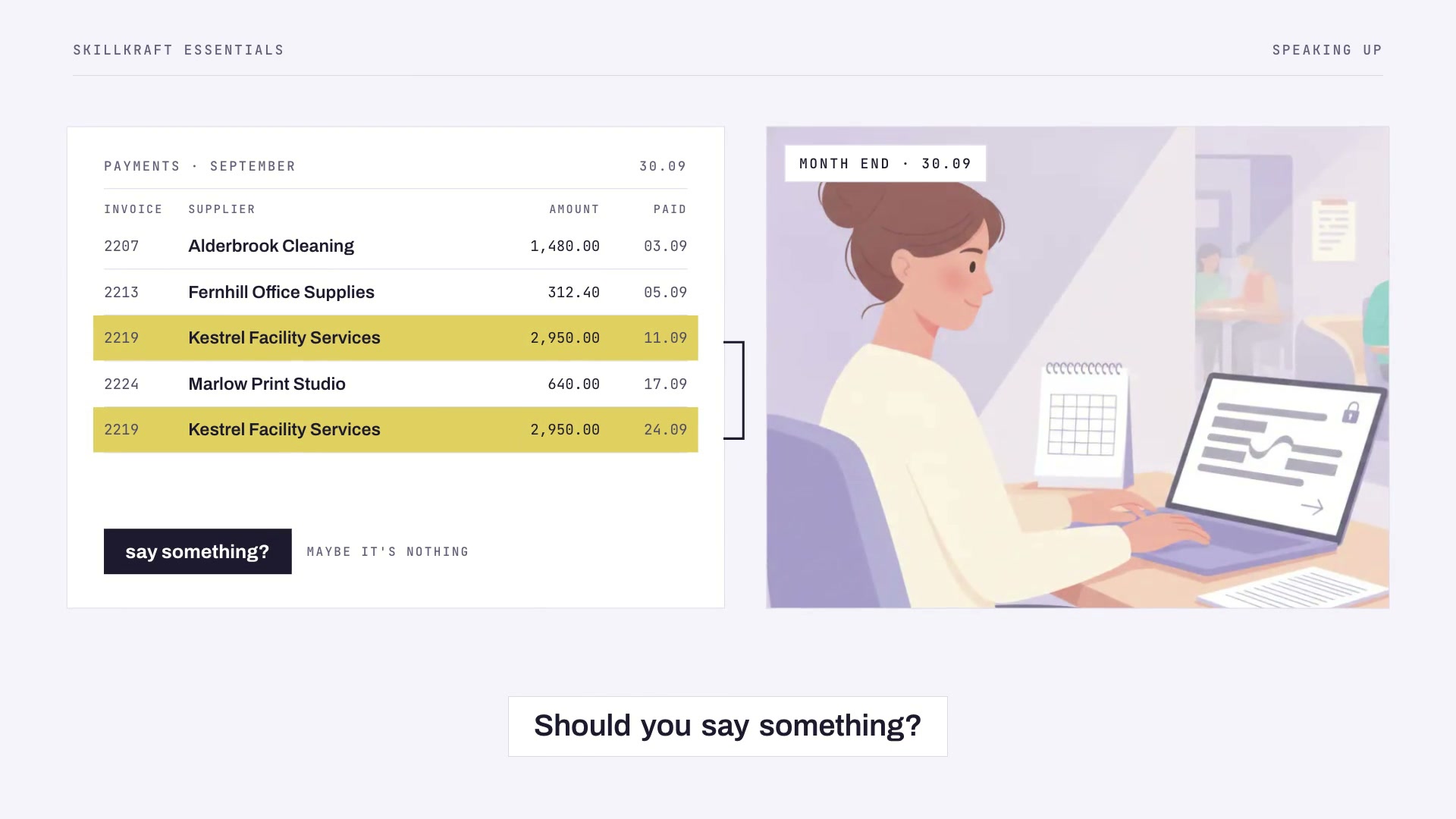
Intro film · about 1 minLesson 1 of 5
[01] The story
Meet Elif.
 Elif's story
Team assistant in the purchasing team of a food wholesaler. Monday, 10:15, filing last month's invoices. She stops. Invoice 7731 from the facilities supplier, 2,480 euros: paid on 3 March. And here it is again, same number, same amount: paid on 17 March. Frank approved both. Frank, who has been here twenty years and showed Elif everything in her first week. She closes the folder. It's probably nothing. It's not her job. Is it?
What would you do? The course follows Elif through 5 everyday moments like this one.
[02] Try it now
Find the red flags yourself.
A real exercise from lesson 3, exactly as it appears in the course.
No sign-up needed. Tap, check, and see why.
spot the red flags
Elif's first draft
Tap every part that is a guess, a label, a rumour or snooping. The facts can stay.
dotted lines can be tapped. Not all of them are red flags.
ToReporting channel (web form)
Subject
[03] What you'll be able to do
What employees learn about reporting a concern
01Lesson 1
Explain why raising a concern early helps everyone, and name four kinds of concern.
02Lesson 2
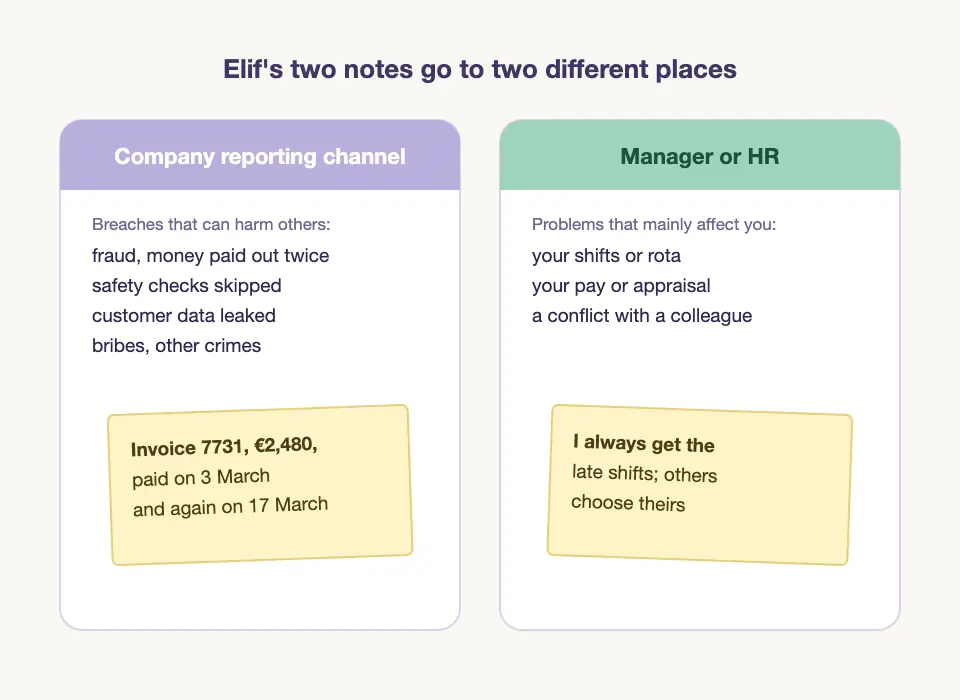
Tell a reportable breach from a personal grievance, and know which route each one takes.
03Lesson 3
Choose a sensible route and write a short, factual report.
04Lesson 4
Explain how people who report are protected, and what is not protected.
05Lesson 5
Respond well when a colleague brings you a concern: listen, don't investigate, pass it on, keep it confidential.
FinalQuiz
Prove it: 8 of 10 right and the course is complete.
[04] Lesson by lesson
What the speaking-up course covers
Short lessons you do, not watch: a scene from the story, then exercises that check you got it.
Lesson 1: Why Speaking Up Matters
Most problems at work start small.
You'll be able to: explain why raising a concern early helps everyone, and name four kinds of concern.
- Match the pairs
- Sort real examples
- A step-by-step diagram
- 5 quick questions

Lesson 2: Report It or Talk to Your Manager?
Not every problem at work is a case for the whistleblowing channel.
You'll be able to: tell a reportable breach from a personal grievance, and know which route each one takes.
- Match the pairs
- Sort real examples
- 5 quick questions
Lesson 3: How to Report a Concern
You've noticed something, and it's more than an everyday grievance.
You'll be able to: choose a sensible route and write a short, factual report.
- Spot the red flags
- Put the steps in order
- Match the pairs
- 4 quick questions

Lesson 4: Protection and Confidentiality
The biggest reason people stay quiet is fear: of payback, of being known, of being wrong.
You'll be able to: explain how people who report are protected, and what is not protected.
- Spot the red flags
- Put the steps in order
- Match the pairs
- 2 quick questions

Lesson 5: If Someone Comes to You
Sometimes you're not the one with the concern.
You'll be able to: respond well when a colleague brings you a concern: listen, don't investigate, pass it on, keep it confidential.
- Choose what happens next
- Put the steps in order
- Match the pairs
- 3 quick questions

Final Quiz
10 questions from the 5 lessons. 8 right to pass, and you can try again as often as you like.
[05] For companies
Give this course to your team
- 01Assign it to everyone who needs it, in your own Skillkraft Academy.
- 02See who has started, who has finished, and every final-quiz score.
- 03Download the list as a CSV file when an auditor asks.
- 04All six Essentials are included in every academy.
Sign-in with Google today. Microsoft sign-in soon.
| Name | Status | Final quiz | Completed on |
|---|---|---|---|
| Jonas Wagner | Completed | 9 / 10 | 07.10. |
| Ana Novak | Completed | 10 / 10 | 07.10. |
| Marco Rossi | In progress | — | — |
| Sophie Hoffmann | Completed | 8 / 10 | 08.10. |
| Karin Lindqvist | Not started | — | — |
[06] Questions
Good to know
Is it really free?
Yes. The course costs nothing to take. Send your name and email, we set up your place, and you start with lesson 1.
How long does it take?
About 35 minutes: 5 short lessons and a final quiz. Do it in one sitting or a lesson at a time; your progress is kept.
What happens at the end?
A final quiz of 10 questions. Get 8 right and the course is complete, in your name. You can try again as often as you like.
Do I need any background?
Any employee or team leader. No legal background needed.
Does it work on my phone?
Yes. Every lesson, exercise and the quiz work on a phone, a tablet or a laptop.
Is this legal advice?
General guidance, not legal advice. Your company adds its own contacts and rules.
Can my company give it to the whole team?
Yes. In your own Skillkraft Academy you assign it, see who has finished, and download the list for audits. All six Essentials are included.
35 minutes well spent
Send your name and email, and we set up your place. Nothing to pay.
General guidance, not legal advice. Your company adds its own contacts and rules.